
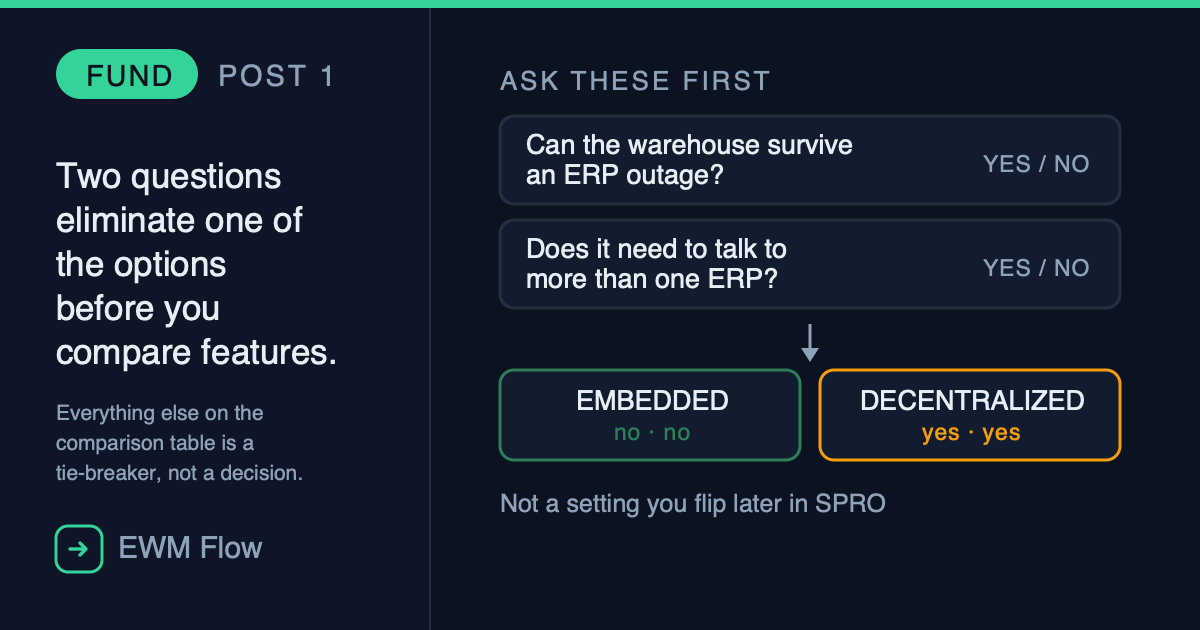
Every SAP EWM overview explains the difference between embedded and decentralized deployment in one sentence: one runs inside your S/4HANA client, the other runs on its own system. True, and almost useless. It doesn’t tell you which one your warehouse actually needs — and this is not a setting you flip later in SPRO. It’s an architecture decision baked into your system landscape before the first delivery ever moves.
What «Embedded» Actually Means
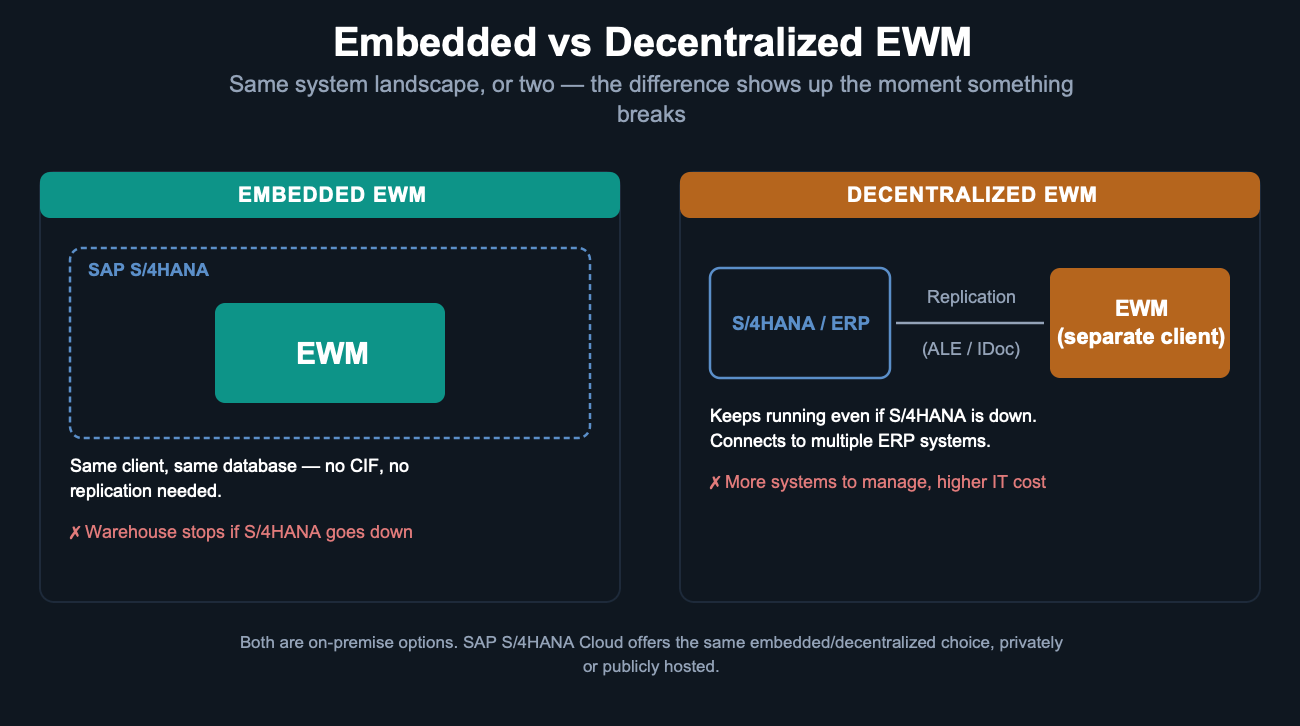
Embedded EWM installs the warehouse management functionality on the exact same client as your SAP S/4HANA system. There’s no second system, no second client, no interface layer translating between the two — EWM reads business partner, material, and batch master data directly from the S/4HANA tables it already lives next to.
That closeness is the whole value proposition:
- Simpler system structure than decentralized EWM — one landscape, not two.
- No Core Interface (CIF) required to keep master data in sync, because there’s nothing to sync.
- Transactional data — purchase orders, production orders — is read directly, not replicated.
- No extra documents. Outbound deliveries don’t need to be re-created as a separate object for EWM to work with; embedded EWM works with what S/4HANA already has.
- Lower cost. Basic embedded EWM functionality is included in the standard SAP S/4HANA license — no separate SAP EWM license line for the basic scope.
But that same closeness is also the ceiling:
- If the ERP system goes down, the warehouse goes down. There’s no independent EWM system to keep running while S/4HANA is in maintenance.
- It doesn’t flex well for high-volume operations with a large Material Flow System (MFS) footprint — think heavily automated, high-throughput distribution centers.
- You can’t integrate storage locations that live in a different SAP ERP system. Embedded EWM only sees the client it’s embedded in.
SAP’s own guidance is blunt about who this fits: small to medium-sized warehouses, and production warehouses, where one client for both ERP and EWM is a feature, not a limitation.
What «Decentralized» Actually Means
Decentralized EWM is a genuinely separate system — its own client, connected back to the central ERP (SAP S/4HANA or SAP ERP) rather than living inside it. It became available as a deployment option with SAP S/4HANA 1809, Feature Pack Stack 01, as a distinct alternative to the older standalone SAP EWM add-on architecture from the SAP Business Suite era.
Separation, this time, is the value proposition:
- The warehouse keeps running even if the ERP system is down. Goods movements, confirmations, RF transactions — none of it depends on S/4HANA being reachable at that exact moment.
- It handles substantial transaction volumes — the profile decentralized EWM was built for.
- One decentralized EWM landscape can serve multiple warehouses, giving more flexibility over inventory management across sites.
- EWM and S/4HANA can be upgraded independently, without one upgrade forcing the other’s hand.
- Better support for automated warehouses — Material Flow System and automated storage/retrieval system integration is a genuinely stronger fit here than in embedded EWM.
- It can connect to more than one ERP system, which matters if you’re a logistics service provider running one warehouse for several client companies with non-harmonized business partners.
And the ceiling flips too:
- More complex to operate. Two systems instead of one means more moving parts, and that shows up directly in IT infrastructure cost.
- Data replication between S/4HANA and the decentralized EWM client can create sync issues that need real investigation when they show up — this isn’t automatic and invisible the way it is in embedded EWM.
- Higher training and skill requirements, since the teams supporting each system now need to understand two landscapes, not one.
The Decision, Side by Side
| Embedded EWM | Decentralized EWM | |
|---|---|---|
| System landscape | Same client as S/4HANA | Separate client, connected to S/4HANA |
| Keeps running if ERP is down | No | Yes |
| Best fit | Small/medium, production warehouses | High-volume, automated, multi-warehouse |
| Master/transactional data | Read directly, no replication | Replicated, can need sync troubleshooting |
| Multi-ERP support | No | Yes |
| Upgrade independence | No — same landscape, same cycle | Yes |
| Licensing | Basic scope included in S/4HANA license | Full SAP EWM licensing |
If you’re mapping this against your own warehouse right now: the honest first question isn’t «which one is better» — it’s «can this warehouse tolerate an ERP outage, and does it need to talk to more than one ERP system.» Those two answers alone eliminate one of the two options in most real projects.
The Third Option Nobody Mentions First
Between «full embedded EWM» and «full decentralized EWM» sits Stock Room Management — SAP’s lighter-weight option for small, low-complexity warehouses that don’t need the full advanced feature set, and a soft landing for teams still running classic SAP WM who need to move onto S/4HANA without a disruptive rip-and-replace. We cover exactly what it does and doesn’t include in a dedicated post on what happened to SAP WM in S/4HANA — worth reading before you assume your warehouse needs full EWM at all.
One Deadline Worth Knowing Now
If any part of your landscape still runs the older standalone architecture — SAP EWM 9.5 or lower, deployed as a SAP Business Suite add-on on classic SAP NetWeaver — SAP has confirmed that deployment option will not be supported after 2027. That’s not a reason to panic, but it is a reason to know, today, which deployment option each of your warehouses is actually running, before that date becomes urgent instead of informative.
Related Reading
- Inside an SAP EWM Warehouse — where deployment architecture fits in the end-to-end picture
Deja un comentario