
The 3 a.m. Problem Nobody Talks About
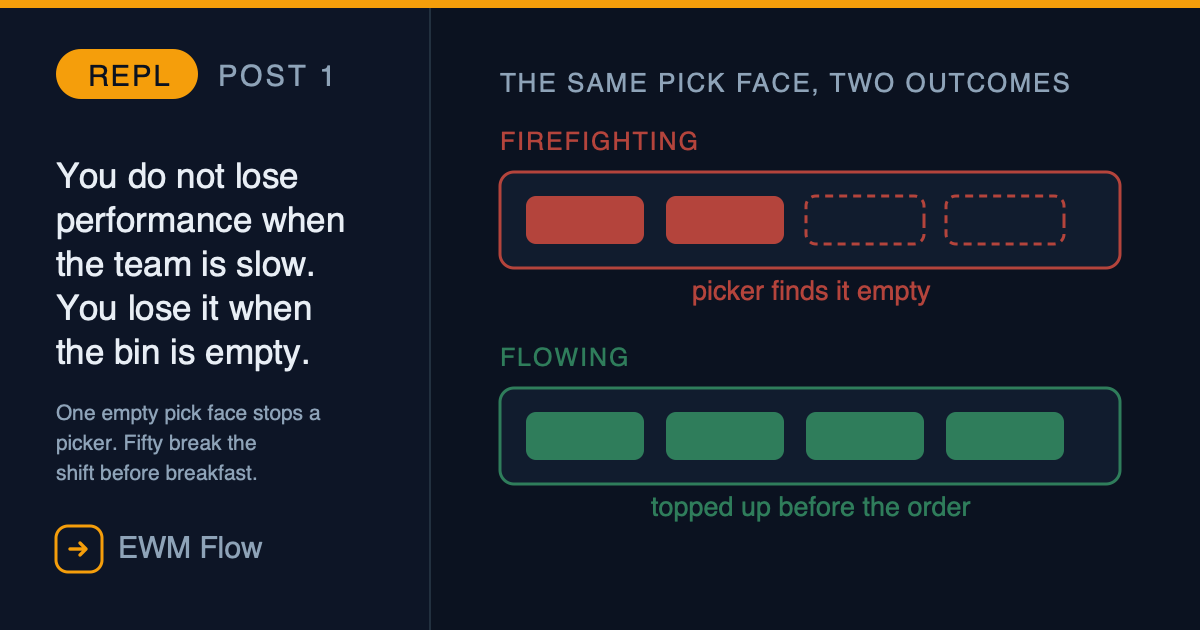
You do not lose warehouse performance when your team is slow.
You lose it when the pick face is empty.
One empty bin can stop a picker.
Ten empty bins can break your wave.
Fifty empty bins can destroy your shift KPIs before breakfast.
That is where replenishment in SAP EWM changes everything.
Replenishment is not just a background process.
It is the invisible system that keeps your operation breathing.
Why This Topic Matters Right Now
Most teams invest in RF speed, labor standards, and dashboards.
But if stock is not in the right place at the right moment, none of that matters.
When replenishment is weak, you get:
– Constant urgent tasks
– Last-minute forklift chaos
– Missed outbound deadlines
– Picker frustration and avoidable overtime
When replenishment is solid, you get:
– Stable pick performance
– Fewer interruptions
– Better wave execution
– Predictable outbound service levels
Replenishment in One Line
Replenishment means moving stock from reserve areas to pick faces before demand hurts execution.
Simple idea.
Huge impact.
The 4 Signals Your Warehouse Needs Better Replenishment
If these are happening in your operation, this series is for you:
– Pickers frequently report empty bins during active waves
– Replenishment tasks are mostly manual and reactive
– Supervisors escalate daily because «stock exists but not where needed»
– Your team spends too much time expediting instead of executing
What You Will Learn in This 5-Post Series
This is not theory-heavy content.
This is execution content.
In this series, we will cover:
– Post 1: Foundations and operating mindset (this post)
– Post 2: Order-Based Replenishment, step by step
– Post 3: Automatic and Planned Replenishment, the proactive minimum-quantity methods
– Post 4: Direct Replenishment, the reactive method for fixed bins
– Post 5: Real case lessons, mistakes, and practical design tips
The Mindset Shift That Changes Results
Most warehouses run replenishment as a support task.
Top-performing warehouses run replenishment as a service-level protector.
That mindset shift changes design decisions:
– From «replenish when empty» to «replenish before risk»
– From «operator memory» to «system signals»
– From «heroic firefighting» to «repeatable flow»
Start Here This Week (Practical Challenge)
Before touching configuration, run this 30-minute check:
– Pick one high-volume zone
– Identify the top 20 SKUs by picks
– Count how many stock-out pick-face events happened in the last 7 days
– Mark how many were predictable
If more than 30% were predictable, your replenishment model is leaking performance.
Final Thought
In EWM, replenishment is not glamorous.
It is strategic.
If picking is the heartbeat of outbound, replenishment is oxygen.
No oxygen, no heartbeat.
In Post 2, we will break down Order-Based Replenishment with practical design choices you can apply immediately.
Discover why replenishment in SAP EWM is the hidden driver of outbound performance and learn the operating mindset that prevents empty pick faces and constant firefighting.
Part of the Replenishment Mastery series
Deja un comentario